Creating the Long Tail
The pitch for becoming a creator used to be simple: find a thousand true fans and you’ll be fine. If each fan pays $100 a year, that’s $100,000 doing what you love. Over time, finding those thousand fans has gotten easier as technology penetrates deeper and Big Tech’s targeting grows more precise each year. It’s now a $300bn+ industry, with ~11.6 million full-time creators in the US alone (which feels absurdly high — US manufacturing employs roughly that many people).
While finding a thousand fans is easier, finding a thousand paying fans is harder. Goldman Sachs estimates only ~4% of creators make over $100k annually, and expects that slice to stay roughly flat as the creator base expands. With AI pushing the marginal cost of content toward zero, the industry could still become far more lucrative. Unsurprisingly, the big labs are best positioned to capture that upside: Meta is launching Vibes (an AI short-video feed), OpenAI is rolling out a Sora-powered social app, and YouTube is plugging Veo 3 into Shorts. It’s worth asking what this means for creators as a profession and for the rest of us as consumers.
We can map the new landscape on two axes: front-end identity (who the audience sees) and back-end production (how the content is made). For years, we’ve mostly lived in the top-right quadrant—classic YouTubers filming and editing their own work. More recently, the top-left has grown: virtual influencers “puppeteered” by humans to connect with audiences.
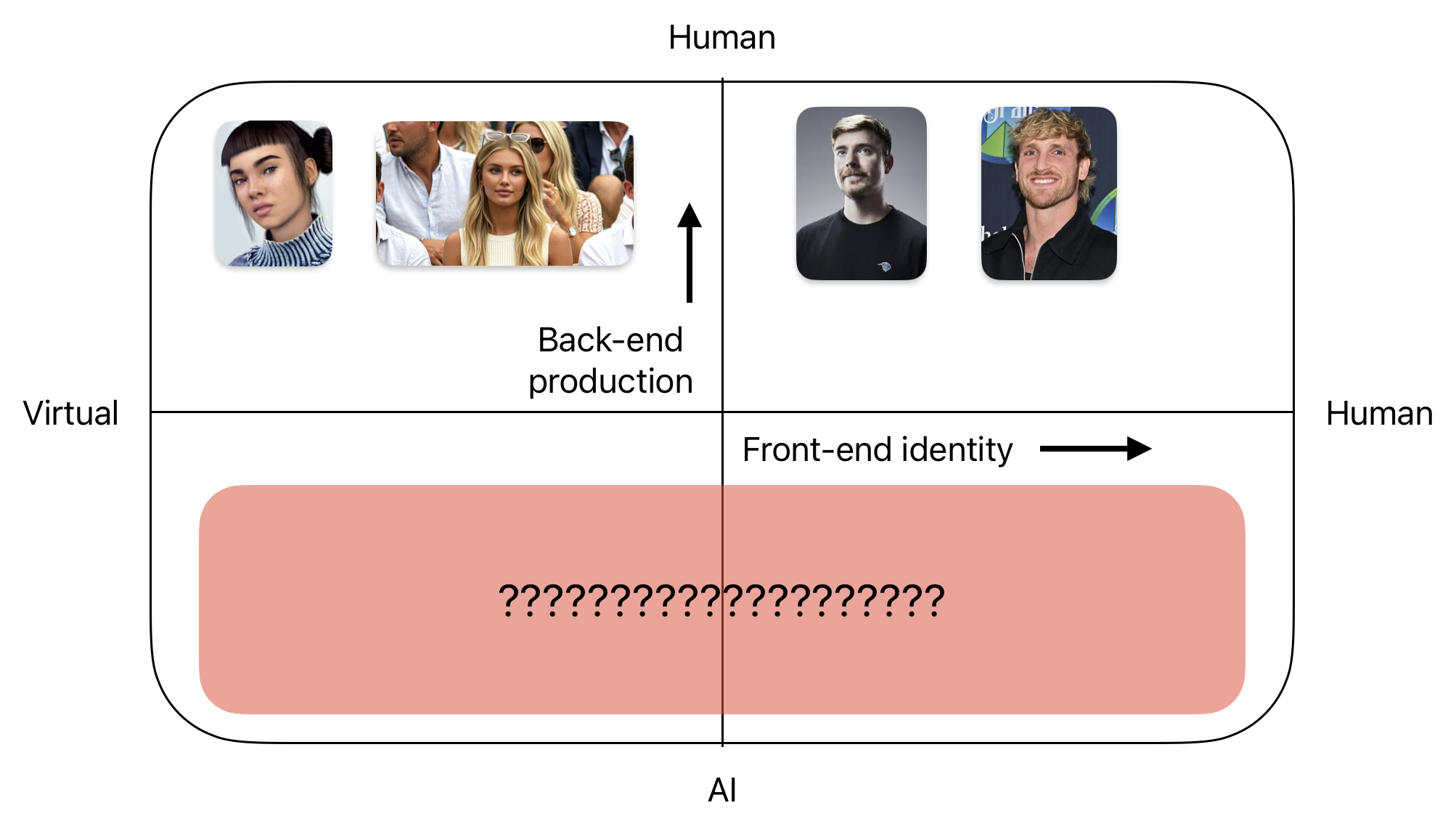
AI is colonizing the bottom half of the map. Many human creators will augment their workflow with AI (bottom-left). But the truly explosive growth will be bottom-right: fully synthetic media; effectively infinite, effectively free.
AI-generated output will dwarf what human creators can produce solo. As that reality sinks in, more creators will co-produce with AI and speed up their release cadence. Unless we consciously prefer human-made work, many creators may struggle to avoid being drowned out in the glut. Finding your true 1,000 fans could become harder than ever.
For consumers, the upside is obvious: more choice, better fit. Soon, feeds may surface dynamically generated videos tailored to your current needs. Say you’re furnishing a home and the couch is next. Based on the other furniture clips you’ve watched, the models infer the gap, then surface Wayfair links or auto-generated “couch inspiration” shorts. OpenAI and Google have a unique edge here: if you’ve asked ChatGPT or Gemini for home-decor ideas, they already know your project before you even open the AI social app.
The best outcome might be that recondite interests finally reach audiences in the formats they prefer. K-pop stars as Labubu dolls set in the Demon Slayer universe? If you can imagine it, you can summon it.